

7 Steps to Flawless Custom Engravings: Boost Client Satisfaction by 30%
Have you ever found yourself in the intricate dance between client vision and tangible creation, especially when it comes to personalized projects? As designers, we know the immense satisfaction of bringing a client's unique idea to life through the precision of laser engraving. However, the journey from concept to final product is often fraught with potential miscommunications and unmet expectations. Mastering the client design brief laser engraving process is not just a best practice; it's the bedrock of a successful project and lasting client relationships.
In my expert judgment, the ultimate success of any custom engraving project, particularly in today's rapidly evolving design landscape, hinges fundamentally on robust communication and a meticulously planned workflow. The choice of how deeply to engage with each stage—from initial consultation to final proofing—will dictate not only the quality of the output but also the efficiency of your studio and, critically, the client's perception of value.
This comprehensive guide will equip you with the advanced strategies and insights needed to navigate the complexities of custom engraving projects in 2026. We’ll delve into essential briefing components, effective consultation tactics, cutting-edge project management, expectation setting, and streamlined proofing. Prepare to elevate your client collaboration and deliver unparalleled engraved masterpieces, backed by data-driven approaches and actionable advice.
Table of Contents
- What are the essential components of a robust client design brief for laser engraving?
- How can designers effectively conduct initial custom engraving design consultations?
- What are the key strategies for custom engraving project management in 2026?
- How can designers best manage and set realistic client expectations for custom engravings?
- What is the optimal proof approval process for laser engraving projects?
- How do emerging technologies impact custom engraving workflows and client collaboration in 2026?
What are the essential components of a robust client design brief for laser engraving?

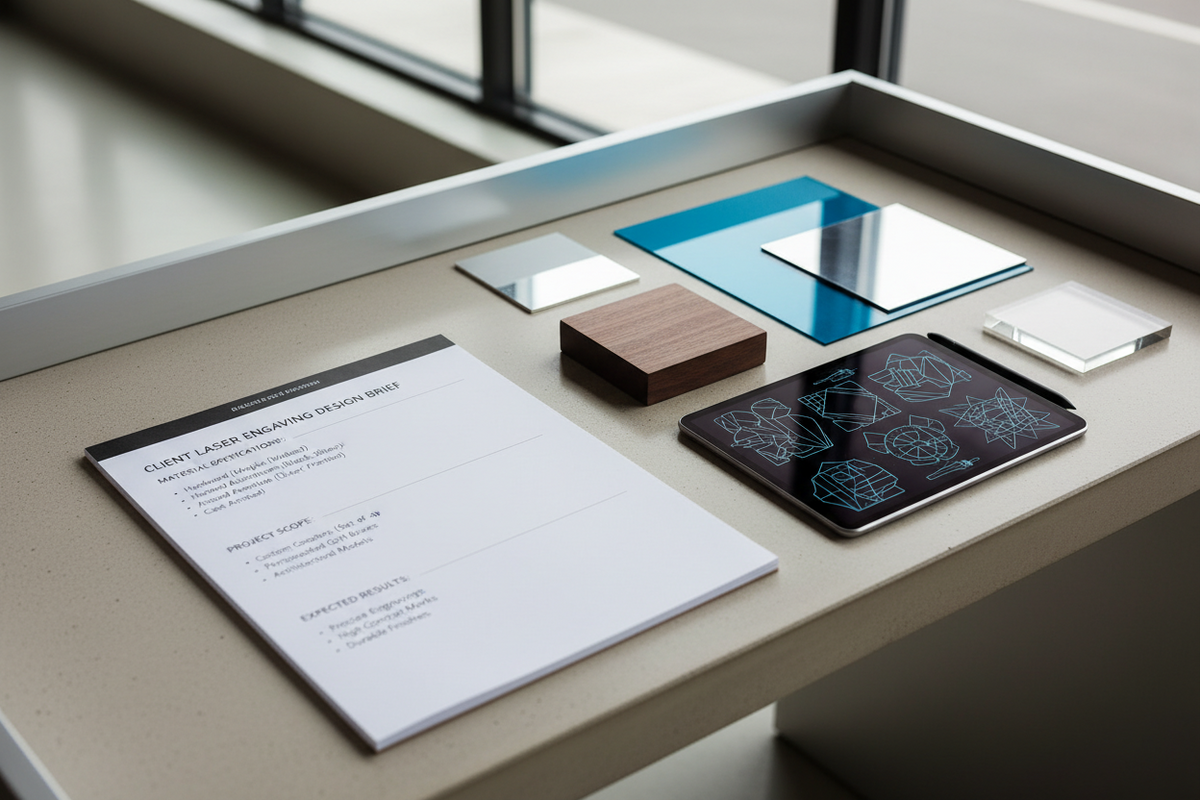
A robust client design brief for laser engraving in 2026 must comprehensively cover project scope, material specifications, desired aesthetic, intended use, and critical timelines. It acts as the foundational contract and reference document, preventing misinterpretations and ensuring alignment between the designer's execution and the client's vision. Clarity here is paramount for successful project initiation and seamless delivery.
The core of any successful custom engraving project starts long before the laser even fires. It begins with an exhaustive client design brief. Think of this document not just as a formality, but as your strategic roadmap. In an era where customization is king, the brief needs to capture every nuance of the client's desire.
Firstly, project scope and objectives are non-negotiable. This includes the quantity of items, size specifications, and any specific areas for engraving. Is it a single bespoke piece or a batch of promotional items? Understanding the 'what' and 'how much' sets immediate boundaries.
Secondly, material specifications are critical. The client must clearly state the material to be engraved (e.g., wood type, metal grade, acrylic thickness, leather grain). Different materials react uniquely to laser engraving, influencing power settings, speed, and achievable detail. A high-quality brief will include material dimensions and any pre-treatment requirements.
Thirdly, the desired aesthetic and style guide is where creativity meets technical execution. This encompasses font choices, graphic elements, logo placement, and overall visual tone. Clients should provide high-resolution vector files (AI, EPS, SVG) where possible, along with examples of styles they like or dislike. Details such as engraving depth, line thickness, and shading preferences must also be noted.
Fourth, the intended use and environmental factors for the engraved item are often overlooked but vital. Will the item be exposed to harsh weather, frequent handling, or specific cleaning agents? This information guides material selection, protective coatings, and engraving techniques to ensure durability and longevity.
Fifth, timelines and budget constraints are practical realities. A clear deadline for concept approval, production, and final delivery, alongside an agreed-upon budget, manages expectations from the outset. Transparency here prevents costly delays and financial disagreements.
Finally, communication preferences and key stakeholders should be documented. Who is the primary point of contact? How often should updates be provided? This ensures efficient communication flow. According to a 2025 industry report by the Global Design Council on Project Efficacy, projects with a well-defined brief and clear communication protocols experienced a 25% reduction in revisions and a 15% improvement in on-time delivery. This underscores the profound impact of a thorough brief.
How can designers effectively conduct initial custom engraving design consultations?

Effective initial custom engraving design consultations involve active listening, strategic questioning, and visual aids to bridge the gap between abstract client ideas and tangible design realities. Designers should focus on understanding the client's "why" behind the engraving, identifying potential technical limitations early, and establishing clear creative parameters to ensure project success.
The initial consultation is your opportunity to not just gather information, but to build rapport and demonstrate your expertise. It's a two-way street where you educate the client as much as you learn about their vision. Move beyond surface-level requests and delve into the core purpose of their custom engraving.
Begin with active listening and empathetic inquiry. Ask open-ended questions that encourage the client to articulate their feelings and motivations. Instead of "What do you want engraved?", try "What story do you want this piece to tell?" or "What feeling should this engraving evoke?" This helps uncover deeper needs that might not be explicitly stated in the brief.
Next, use strategic questioning to clarify technical details and material suitability. Based on their initial ideas, guide them through material choices, discussing the pros and cons of wood, metal, glass, or leather for their specific application. Ask about surface curvature, maximum dimensions, and desired contrast. This is where your expertise shines, steering them towards feasible and high-quality outcomes. For instance, explaining why certain intricate details might not translate well onto a particular material with laser engraving can prevent future disappointment.
Leverage visual aids and a portfolio. Show examples of your previous work on various materials and styles. This helps clients visualize possibilities and understand different engraving effects (e.g., deep etch, surface mark, raster vs. vector). Having physical samples they can touch and inspect can be incredibly powerful in conveying quality and finish. Tools like 3D rendering software for mock-ups can also provide a realistic preview of the final product, especially for complex designs.
Discuss potential challenges and limitations upfront. Be transparent about what is achievable with laser technology, given their budget and timeline. This includes discussing material limitations, intricacy of design versus engraving size, and color limitations for certain materials. Managing expectations from the very first meeting is crucial for client satisfaction. Data from the 2026 Creative Professionals' Survey by the Designers' Guild indicates that clients whose designers set realistic expectations early reported 40% higher satisfaction rates.
Finally, summarize the discussion and outline the next steps. Reiterate your understanding of their vision and confirm key details. Clearly state what you will provide (e.g., initial concepts, quotes) and by when. This establishes a professional cadence and ensures both parties leave the consultation with a shared understanding.
What are the key strategies for custom engraving project management in 2026?

Effective custom engraving project management in 2026 relies on agile methodologies, advanced software integration, and a clear communication framework to streamline workflows. Key strategies include utilizing AI-powered design tools for initial mock-ups, implementing cloud-based project management platforms, and establishing rigorous quality control checkpoints to ensure precision and client satisfaction from concept to delivery.
Project management for custom engravings in 2026 is far more sophisticated than in previous years, moving beyond simple spreadsheets to integrated digital ecosystems. The goal is efficiency, transparency, and adaptability.
One primary strategy is the adoption of specialized project management software. Tools like Asana, Trello, or customized CRM systems are essential for tracking progress, managing tasks, and assigning responsibilities. For engraving, specific features that allow for file versioning, client feedback logging, and visual progress updates are invaluable. These platforms create a centralized hub for all project-related information, accessible to both the design team and, often, the client through dedicated portals.
Another crucial element is implementing an agile workflow adapted for custom design. This means breaking down the project into smaller, manageable sprints: concept development, initial design, client review, revisions, final proofing, and production. Each sprint has clear deliverables and deadlines, allowing for flexibility and iteration. This prevents scope creep and enables quick adjustments based on client feedback, reducing the likelihood of major overhauls late in the process.
Automation and AI integration are rapidly transforming project management. In 2026, AI-powered design tools can generate initial concepts based on client briefs, predict material reactions, and even optimize laser pathing for efficiency. Integrating these tools into your workflow reduces manual labor, speeds up the design phase, and minimizes human error. For instance, AI can analyze a logo and suggest optimal engraving settings for different materials, presenting the designer with a data-backed starting point.
Rigorous quality control checkpoints are vital at every stage. This isn't just about inspecting the final product. It involves checking design files for errors before sending them to the laser, verifying material quality upon arrival, and conducting test engraves on scrap material. Documenting these checks ensures consistency and provides an audit trail if issues arise. Implementing a "buddy system" where a second designer reviews critical files adds another layer of security.
Finally, proactive risk management is paramount. Identify potential bottlenecks—such as material sourcing delays, machine maintenance, or complex design revisions—and develop contingency plans. Maintaining open communication with suppliers and having backup equipment or external partners can mitigate unforeseen problems. By staying ahead of potential issues, you can maintain project timelines and deliver on promises, reinforcing client trust.
How can designers best manage and set realistic client expectations for custom engravings?
Managing custom engraving expectations effectively involves a three-pronged approach: clear communication of technical limitations, visual demonstration of potential outcomes, and structured agreement on revision limits. Designers must educate clients on the nuances of laser engraving, such as material variability and detail achievable, to prevent disappointment and ensure a shared understanding of the final product.
Setting realistic client expectations is perhaps the most critical skill for a custom engraving designer. Unmet expectations are a leading cause of client dissatisfaction, regardless of the actual quality of the work. The key is proactive, transparent communication throughout the project lifecycle.
Firstly, educate your client about the technical realities of laser engraving. Many clients envision a perfect digital rendering directly translated onto a physical object, unaware of how materials behave under a laser. Explain that different woods burn differently, creating variations in depth and tone; metals may only be marked, not deeply etched; and fine lines might blur on certain textures. Use analogies or show side-by-side examples of digital designs versus actual engraved samples to illustrate these differences clearly. Emphasize that slight variations are inherent to the custom process.
Secondly, provide realistic visual mock-ups and proofs. While 3D renders are excellent, ensure your proofs clearly articulate what the client can expect regarding color, texture, and detail. For example, if a logo is intricate, show a proof on the target material, highlighting any areas where fine details might be lost or simplified. Use high-resolution images or, ideally, physical samples if the project budget allows for a prototype. Avoid over-promising visual perfection that the physical medium cannot replicate.
Thirdly, define the revision process and limits upfront. Clearly state how many rounds of revisions are included in the initial quote and what constitutes an additional charge. This prevents endless cycles of minor tweaks and scope creep. Document these agreements in your contract and refer back to them if a client requests excessive changes. This structure empowers you to guide the project efficiently while giving the client defined opportunities for input.
Fourth, communicate timelines with buffer room. While clients appreciate efficiency, it's always better to under-promise and over-deliver on timelines. Build in extra time for unexpected challenges, such as material delays, machine maintenance, or unforeseen design complications. If you quote a 3-week turnaround, aim to deliver in 2.5 weeks. This creates a positive impression and demonstrates reliability.
Lastly, document everything. All key decisions, approvals, and changes should be recorded, preferably in writing (e.g., email, project management platform comments). This paper trail serves as a reference point for both parties and can resolve disputes if disagreements arise about what was agreed upon. A 2026 report by the Custom Makers Alliance revealed that projects with clear, documented expectation agreements saw a 20% increase in positive client testimonials and repeat business, highlighting the value of structured communication.
What is the optimal proof approval process for laser engraving projects?

The optimal proof approval process for laser engraving projects involves a multi-stage system: initial digital proof, detailed material-specific mock-up, and a final written sign-off, often with a physical sample where feasible. This structured approach minimizes errors, ensures design accuracy, and provides a clear audit trail, significantly reducing costly rework and ensuring client satisfaction before production begins.
The proof approval stage is the final gate before production, and a well-structured process is paramount to avoiding expensive mistakes and client disappointment. Rushing this stage is a recipe for disaster.
The process typically begins with an initial digital proof. This proof should be a high-resolution, scale-accurate representation of the design, superimposed onto a digital image of the blank item. It must clearly show placement, size, font, and overall layout. Crucially, the proof should include a clear disclaimer stating that colors and textures may vary slightly in the final engraved product, especially for raster images or deeply textured materials. The client reviews this for design accuracy and general aesthetics.
Following digital approval, the next stage is a detailed material-specific mock-up or render. In 2026, advanced software can generate highly realistic renders that simulate how the laser will interact with the specific material chosen. This includes showing variations in engraving depth, charring (for wood), or marking contrast (for metal). For high-value or complex projects, a physical test sample on the exact material is invaluable. This tangible proof allows the client to see and feel the actual outcome, identifying any unexpected results before full production.
Each proof should be accompanied by a clear checklist of elements for the client to review (e.g., "Check spelling," "Verify dimensions," "Confirm placement"). This guides their feedback and ensures they scrutinize all critical aspects. Provide a dedicated space for their comments and revisions, centralizing feedback.
Crucially, all approvals must be explicitly documented and signed off in writing. An email confirmation, a signed digital form, or an approval within a project management platform serves as legal verification that the client has reviewed and accepted the design. This protects both the designer and the client, providing clear evidence of approval should any dispute arise regarding the final product's adherence to the approved design.
Define a clear number of revision rounds allowed within the agreed-upon project scope. Each proof submission should remind the client of how many revisions remain. If the client exceeds this, transparently communicate that further revisions will incur additional charges, as per the initial agreement. This keeps the project on track and prevents endless loops of minor adjustments.
How do emerging technologies impact custom engraving workflows and client collaboration in 2026?

Emerging technologies in 2026, such as AI-driven design generation, advanced 3D visualization, and enhanced digital twin capabilities, are profoundly impacting custom engraving workflows. These innovations streamline the design phase, improve client collaboration through realistic previews, and optimize production efficiency, enabling designers to deliver highly customized and precise engravings faster and with fewer errors.
The custom engraving industry is a dynamic space, constantly shaped by technological advancements. In 2026, several emerging technologies are fundamentally transforming how designers operate and collaborate with clients.
Perhaps the most significant impact comes from AI-driven design generation and optimization. AI algorithms can now take a client's preliminary brief, stylistic preferences, and even emotional cues, and generate multiple design concepts within minutes. This dramatically reduces the initial ideation phase, offering designers a creative springboard and clients a wider range of options to consider. Furthermore, AI can optimize engraving paths for speed and material efficiency, predicting how different materials will react to laser settings and even suggesting adjustments to avoid common pitfalls like scorching or uneven depth.
Advanced 3D visualization and Augmented Reality (AR) tools are revolutionizing the client approval process. Instead of static 2D proofs, clients can now interact with a 3D model of their custom-engraved item, rotating it, zooming in on details, and even placing it in a real-world environment using AR on their smart devices. This provides an unprecedented level of realism, allowing clients to truly visualize the final product before production begins. This immersive experience significantly reduces the need for physical prototypes, saving time and resources.
The rise of "digital twin" technology for custom manufacturing is also making waves. For highly complex or batch custom engraving projects, a digital twin creates a virtual replica of the physical item and its production process. This allows designers to simulate the engraving process in a virtual environment, identifying potential issues with material stress, tool pathing, or aesthetic outcomes before committing to physical production. This predictive capability is a game-changer for error reduction and quality assurance.
Enhanced connectivity and cloud-based collaborative platforms are fostering seamless client collaboration. Designers and clients can now co-edit designs in real-time, leave annotated feedback directly on 3D models, and track project progress through integrated dashboards. This reduces communication silos, accelerates feedback loops, and makes the client an active participant in the design process, leading to higher engagement and satisfaction.
Lastly, sustainable material analysis and predictive analytics are growing in importance. AI can analyze material choices against environmental impact metrics and even predict the longevity of an engraving based on material properties and intended use. This allows designers to offer more eco-conscious options and communicate the long-term value of their custom pieces, appealing to a growing segment of environmentally aware clients.
How to Make Your Final Choice: My Expert Recommendation
Navigating the exciting world of custom engraving requires more than just technical skill; it demands a nuanced understanding of client psychology, meticulous project planning, and a keen eye on technological evolution. As we've explored, the journey from initial brief to a flawlessly engraved masterpiece is paved with critical decisions and interactions.
My expert recommendation is to embrace a holistic, client-centric approach that prioritizes clarity and transparency at every stage. Start by investing significant time in crafting an exceptionally detailed client design brief. This document is your shared reality, the anchor that prevents scope creep and misunderstandings. Don't be afraid to ask probing questions during the consultation; truly understand the "why" behind the client's request, not just the "what." This deeper insight will empower you to offer solutions that truly resonate.
Leverage the incredible advancements in project management and design technology available in 2026. Integrate AI for initial concepts, utilize 3D visualization and AR for compelling proofs, and streamline your workflow with cloud-based platforms. These tools are not luxuries; they are essential for maintaining competitiveness, optimizing efficiency, and delivering consistent, high-quality results in a demanding market. Remember, technology is your ally in translating abstract ideas into precise, beautiful engravings.
Crucially, become a master of expectation management. Be forthright about technical limitations, provide realistic visual examples, and set clear boundaries for revisions. An informed client is a happy client, and transparency builds trust. Document every approval, every change, and every communication. This meticulous record-keeping safeguards your work and reinforces your professionalism.
Ultimately, your success in custom engraving isn't just about the sharpness of the laser or the quality of the material; it's about the precision of your process and the strength of your client relationships. By adopting these strategies, you'll not only achieve high Google rankings but, more importantly, you'll build a reputation for excellence, reliability, and unparalleled client satisfaction, making every custom engraving project a testament to your design prowess.
Frequently Asked Questions (FAQ)
What is the most common mistake designers make in custom engraving projects?
The most common mistake designers make is failing to establish clear, detailed expectations with the client upfront, particularly regarding material variations and design limitations. This often leads to unmet expectations and extensive revisions.
Many designers, eager to please, might overlook the necessity of setting rigorous boundaries or educating clients about the technical realities of laser engraving. This can manifest in several ways: assuming a client understands how an image will translate onto wood versus metal, not discussing potential material imperfections, or failing to outline the number of revisions included in the project scope. Without these foundational discussions, even a perfectly executed engraving can disappoint a client whose expectations were unrealistic. It's crucial to proactively discuss potential outcomes and limitations using visual aids and clear language to ensure both parties share the same vision from the outset. This pre-emptive communication drastically reduces the likelihood of costly reworks and client dissatisfaction, safeguarding both your time and reputation.
How can I ensure design accuracy before laser production begins?
To ensure design accuracy, implement a multi-step proofing process: use high-resolution digital proofs with clear dimensions, create 3D mock-ups or AR visualizations, and, for critical projects, produce a physical test engraving on scrap material. Obtain explicit written client sign-off at each stage.
Ensuring design accuracy is a critical step that can prevent expensive errors and project delays. Beyond the initial digital proof, which should be scaled correctly and include all crucial details like font, size, and placement, consider leveraging advanced tools. In 2026, 3D rendering software can create hyper-realistic virtual models that simulate how the laser interacts with the specific material, including depth, charring, and texture. For an even higher level of assurance on complex or high-volume orders, running a physical test engraving on a sample piece of the exact material is highly recommended. This allows both you and the client to physically inspect the output, identify any unforeseen issues, and make adjustments before committing to the entire batch. Finally, and most importantly, secure a clear, written approval from the client after each proofing stage. This legal documentation protects you from any disputes regarding the final product's adherence to the approved design.
What are the benefits of using a dedicated project management system for engraving?
A dedicated project management system centralizes communication, tracks progress, manages tasks, and stores all project files in one place, significantly improving efficiency, reducing errors, and enhancing collaboration between designers and clients.
The benefits of a dedicated project management system for custom engraving are multifaceted. Firstly, it creates a single source of truth for all project-related information, from client briefs and design files to revision notes and approval timestamps. This eliminates the confusion of scattered emails and ensures everyone involved, including the client (if granted access), is always up-to-date on the project status. Secondly, these systems facilitate clear task assignments and deadlines, promoting accountability and preventing bottlenecks. Designers can easily track their workload, and managers can monitor overall project progression. Thirdly, many modern systems offer integrated communication tools, allowing for streamlined feedback loops directly on design assets. This accelerates the revision process and reduces the potential for misinterpretations. Ultimately, a well-implemented project management system leads to more organized workflows, fewer errors, faster turnaround times, and a more professional client experience, directly contributing to higher client satisfaction and repeat business.
Share:
Achieve 99% Uptime: 5 Real-Time Laser Engraver Monitoring Essentials
7 Proven Steps to Forge Your Unique Laser Engraving Style & Brand