



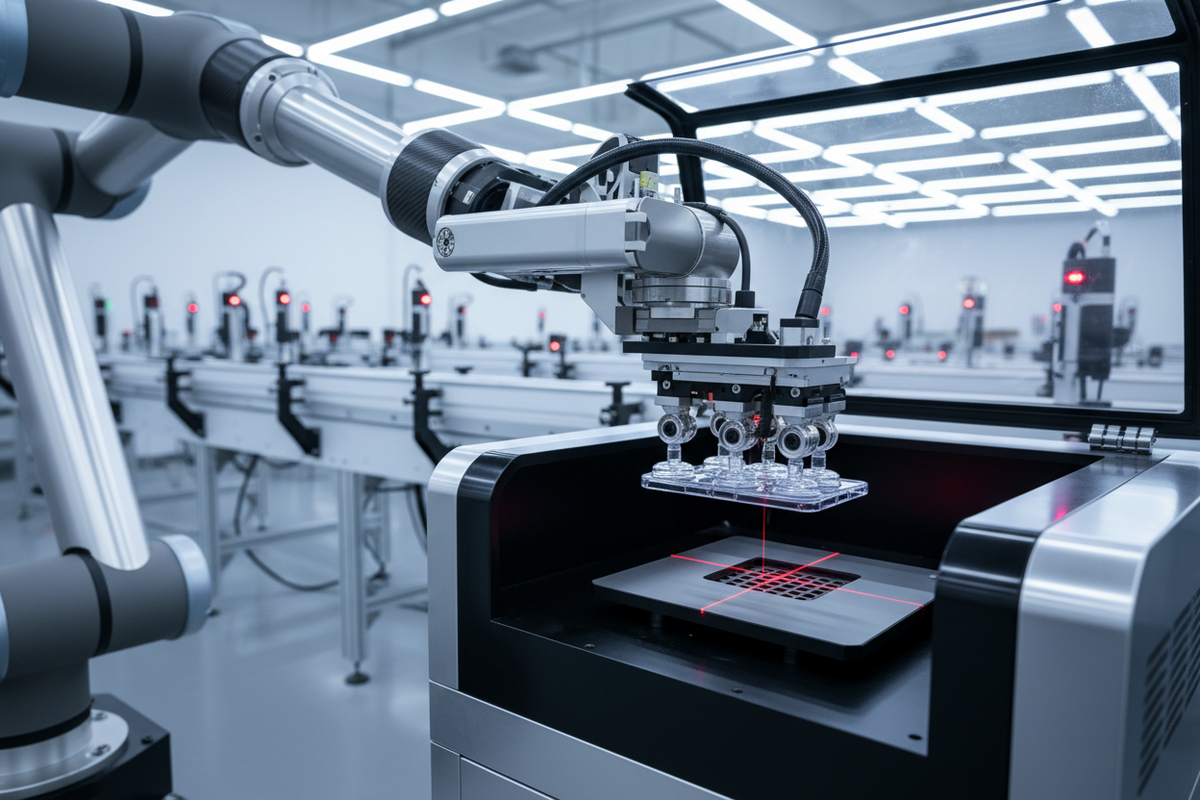
Boost Output by 30%: Robotic Material Handling for Laser Engravers
Are you facing bottlenecks in your laser engraving operations, or constantly seeking ways to enhance productivity and reduce manual labor? I believe that embracing robotic material handling for laser engravers is no longer an option but a strategic imperative for any forward-thinking manufacturing facility by 2026.
From my perspective as an industry expert, the shift towards fully automated laser engraving is accelerating, driven by advancements in robotics, AI, and sensor technologies. The choice to adopt these solutions depends not just on your current production volume, but on your strategic vision for efficiency, scalability, and competitive advantage in a rapidly evolving market.
In this comprehensive guide, we'll delve into the intricacies of automating your laser engraving workflow, exploring everything from the core concepts of robotic integration to the tangible benefits of lights-out production. Prepare to uncover data-backed insights and expert recommendations designed to help you make informed decisions for your operations.
Table of Contents
- What is Robotic Material Handling for Laser Engravers?
- How Do Automated Loading and Unloading Systems Revolutionize Laser Engraving?
- What Are the Key Components of a Successful Lights-Out Production Laser Engraving Solution?
- How Can Businesses Effectively Integrate Cobots with Existing Laser Marking Systems?
- What Are the Primary Benefits and ROI of Optimizing Laser Engraving Workflow Automation?
- What Future Trends Will Shape Automated Material Handling in Laser Engraving by 2030?
What is Robotic Material Handling for Laser Engravers?

Robotic material handling for laser engravers refers to the deployment of automated systems, typically robotic arms or gantries, to load raw materials into and unload finished products from laser engraving machines. This technology aims to eliminate manual intervention in the material transfer process, enabling continuous, high-volume production and enhancing operational consistency. These systems are often integrated with vision systems, conveyor belts, and intelligent software for seamless coordination, making them a cornerstone of modern lights-out manufacturing by 2026.
The concept extends beyond simple pick-and-place. Modern robotic material handling solutions incorporate advanced features such as part recognition, precision alignment, and error recovery protocols. For instance, a robotic arm equipped with a vacuum gripper might precisely lift a delicate smartphone case, place it onto the laser bed, trigger the engraving cycle, and then remove the finished piece, placing it into a designated collection bin or onto a subsequent processing line. This intricate dance of automation reduces cycle times significantly and minimizes the risk of human error or material damage.
In 2026, the versatility of these systems allows them to handle a vast array of materials—from metals and plastics to wood and composites—and various part geometries. They are designed to interface directly with the laser engraving machine’s control system, allowing for real-time communication and synchronized operations. This integration ensures that the laser only fires when a part is correctly positioned, enhancing safety and material utilization. Furthermore, the modular nature of many robotic solutions means they can be scaled up or reconfigured to meet changing production demands, a crucial advantage in today's dynamic manufacturing landscape. The initial investment, while substantial, is often justified by significant long-term savings in labor costs, increased throughput, and improved product quality. According to a recent industry analysis, the global market for industrial robotics in material handling is projected to grow at a CAGR of 10.5% through 2030, highlighting the increasing adoption across various sectors, including precision manufacturing. [Source: Industry Automation Council Robotics Report 2026]
How Do Automated Loading and Unloading Systems Revolutionize Laser Engraving?

Automated loading and unloading systems fundamentally revolutionize laser engraving by transforming it from a semi-manual, stop-and-go process into a continuous, highly efficient operation. They drastically reduce human intervention, leading to substantial improvements in throughput, consistency, and operational safety, making 24/7 "lights-out" production a viable reality. These systems eliminate the need for operators to physically load and unload each workpiece, thereby freeing up valuable human resources for more complex or supervisory tasks.
Historically, laser engraving machines often sat idle during the time it took an operator to remove a finished part and load a new one. This "dead time" significantly hampered overall equipment effectiveness (OEE). Automated systems, however, execute these tasks with machine-like precision and speed, often reducing changeover times to mere seconds. This continuous operation maximizes the utilization of expensive laser equipment, leading to a direct increase in output capacity without necessarily adding more machines.
Moreover, consistency is a major byproduct of automation. Manual loading can introduce slight variations in part placement, which, while sometimes negligible, can accumulate over large batches or affect highly precise engraving tasks. Robots, once programmed, perform the same action repeatedly with micron-level accuracy, ensuring every part is positioned identically. This consistency translates into higher quality finished products and a significant reduction in scrap rates. The ability to operate autonomously also means that production can continue around the clock, even during off-hours, weekends, or holidays, creating a truly scalable manufacturing model for 2026 and beyond. This capability is particularly vital for industries with fluctuating demand or those requiring rapid prototyping and production cycles. For companies aiming to stay competitive, this transition from manual to automated material flow is a game-changer, fostering both efficiency and resilience in their production lines.
What Are the Key Components of a Successful Lights-Out Production Laser Engraving Solution?

A successful lights-out production laser engraving solution in 2026 relies on the seamless integration of several core components: a robust laser engraving machine, advanced robotic material handling systems, intelligent vision systems for part recognition and quality control, sophisticated supervisory software (MES/SCADA), and comprehensive safety protocols. Each element must communicate effectively to enable autonomous, continuous operation. The synergistic interaction of these technologies minimizes human intervention and maximizes productivity.
The foundation is, of course, a high-performance laser engraving machine capable of operating reliably for extended periods. This machine must be equipped with digital interfaces that allow for external control and status reporting. Paired with this is the robotic material handling system, which could be a multi-axis robot arm, an automated guided vehicle (AGV), or a collaborative robot (cobot), designed to handle the specific size, weight, and fragility of the workpieces. These robots are responsible for loading raw blanks from a feeder (e.g., a tray stack, conveyor, or pallet system) and unloading finished parts into another designated output area.
Vision systems play a critical role in ensuring precision and quality. High-resolution cameras and image processing software can identify part types, verify correct orientation, confirm engraving completion, and even inspect for defects post-engraving. This feedback loop is essential for maintaining quality standards without human oversight. The entire system is orchestrated by supervisory software, often a Manufacturing Execution System (MES) or SCADA (Supervisory Control and Data Acquisition) system, which manages production schedules, monitors machine health, collects operational data, and handles error reporting. This software can integrate with enterprise resource planning (ERP) systems for comprehensive business intelligence. Finally, comprehensive safety measures, including perimeter guarding, light curtains, and emergency stop protocols, are paramount to protect any human workers who might occasionally interact with the automated cell. By leveraging these integrated components, manufacturers can achieve true lights-out operation, driving unparalleled efficiency and cost savings. [Source: Robotics Insight Magazine 2026]
How Can Businesses Effectively Integrate Cobots with Existing Laser Marking Systems?

Businesses can effectively integrate cobots with existing laser marking systems by focusing on ease of programming, safety-centric design, and strategic task allocation. Cobots are ideal for repetitive, precise loading/unloading tasks and can work alongside human operators with minimal safety guarding, making them a flexible and cost-effective automation solution, particularly for small to medium enterprises in 2026. Their smaller footprint and inherent safety features simplify deployment compared to traditional industrial robots.
The first step involves a thorough assessment of the existing laser marking system and the specific material handling tasks. Cobots excel at tasks that require moderate payloads and precise, repeatable movements, such as picking up small components from a tray, placing them accurately in a jig for engraving, and then removing them. Choosing a cobot with an intuitive programming interface, often involving lead-through programming where an operator physically guides the robot arm through the desired motions, significantly reduces implementation time and specialized training requirements.
Integration typically involves designing a custom end-effector (gripper) tailored to the specific workpieces being handled. This gripper must securely grasp parts without damaging them and release them cleanly. Communication between the cobot and the laser marking system is crucial. This can often be achieved via digital I/O (input/output) signals, where the cobot signals the laser when a part is ready, and the laser signals the cobot when the engraving is complete. Advanced integrations may use industrial communication protocols like Ethernet/IP or PROFINET for more complex data exchange.
Safety considerations are paramount. While cobots are designed for human-robot collaboration, a risk assessment should always be conducted to ensure safe operation, especially when dealing with laser systems. This might involve setting up "safe zones" or using vision systems to detect human presence. The modularity and relatively low cost of cobots, combined with their ability to be redeployed for different tasks, make them an attractive option for businesses looking to automate incrementally without a complete overhaul of their production line. This approach allows companies to gradually scale their automation efforts, gaining experience and refining processes as they grow. The growth in cobot adoption for precision tasks is expected to continue its upward trajectory through the latter half of the decade, making them a smart investment for enhancing existing laser operations.
What Are the Primary Benefits and ROI of Optimizing Laser Engraving Workflow Automation?
Optimizing laser engraving workflow automation in 2026 yields significant benefits, including dramatically increased throughput (often 30-50% or more), substantial reductions in labor costs, improved product quality through enhanced consistency, and greater operational flexibility. The Return on Investment (ROI) is typically realized within 1-3 years due to these combined efficiencies, making it a compelling strategic move for manufacturers. Automation transforms variable human-driven processes into predictable, machine-driven operations.
One of the most immediate benefits is the surge in production capacity. By eliminating manual loading and unloading times, laser engravers can operate almost continuously, maximizing machine uptime. This directly translates to producing more parts in less time, fulfilling larger orders, and reducing lead times for customers. For example, a single automated cell could potentially replace the output of multiple manual workstations, allowing for redeployment of human capital to higher-value tasks like design, maintenance, or quality assurance.
Labor cost reduction is another major driver. While initial investment in automation can be substantial, the long-term savings from reduced operator wages, benefits, and overtime often prove significant. Furthermore, automation addresses labor shortages, a growing concern for manufacturers globally in 2026. Robots don't require breaks, vacations, or operate limited shifts, ensuring consistent output regardless of human availability. Improved quality control is also a critical benefit. Robots execute tasks with unvarying precision, minimizing errors, misalignments, and defects that can arise from human fatigue or inconsistencies. This leads to higher first-pass yield rates and reduces material waste, further boosting profitability.
Beyond these direct financial gains, automation enhances worker safety by removing personnel from potentially hazardous environments involving lasers and moving machinery. It also provides invaluable data for process optimization, allowing manufacturers to fine-tune their operations based on real-time performance metrics. The competitive advantage gained from faster, more reliable, and higher-quality production solidifies the business's position in the market. Many businesses report achieving full ROI on their automation investments within two years, particularly when factoring in the increased revenue from expanded capacity and reduced operational expenses. [Source: Manufacturing Automation Journal 2026]
What Future Trends Will Shape Automated Material Handling in Laser Engraving by 2030?

By 2030, automated material handling in laser engraving will be profoundly shaped by advancements in Artificial Intelligence (AI) and Machine Learning (ML), hyper-personalization for mass customization, enhanced human-robot collaboration, and the ubiquitous adoption of digital twin technology and cloud-based robotics. These trends will lead to even smarter, more adaptable, and fully integrated production environments. The future promises intelligent systems that learn and adapt.
One significant trend is the deeper integration of AI and ML. Robots will move beyond pre-programmed tasks, using AI to dynamically optimize paths, anticipate maintenance needs, and even adapt to slight variations in materials or part geometries without human intervention. This will make systems more resilient and efficient. For instance, an AI-powered vision system could automatically adjust engraving parameters based on real-time material feedback or detect subtle defects that human eyes might miss, initiating corrective actions immediately.
The rise of hyper-personalization will drive demand for flexible automation. As consumers increasingly desire customized products, laser engraving lines will need to handle highly varied batches efficiently, even down to lot size one. Robotic systems will be crucial here, rapidly reconfiguring themselves with minimal downtime, potentially using modular tooling or quick-change grippers managed by intelligent software. Human-robot collaboration will also evolve. Cobots will become even more sophisticated, with advanced sensors and predictive capabilities allowing them to work more closely and intuitively with human operators, augmenting human capabilities rather than simply replacing them. This means more fluid workflows where humans handle complex decision-making and problem-solving, while cobots manage repetitive physical tasks.
Furthermore, digital twin technology will become standard. Manufacturers will create virtual replicas of their entire automated laser engraving cells, allowing for simulation, optimization, and predictive maintenance in a virtual environment before implementing changes in the physical world. This will drastically reduce commissioning times and potential errors. Cloud-based robotics, enabling remote monitoring, diagnostics, and even programming of robotic fleets from anywhere, will also see widespread adoption, transforming how automation is managed and maintained. These interconnected, intelligent systems will define the next generation of laser engraving production, offering unprecedented levels of efficiency, flexibility, and scalability. The integration of 5G and edge computing will further accelerate these capabilities, ensuring real-time data processing and decision-making directly at the production site. [Source: Future Tech Magazine 2026]
How to Make Your Final Choice: My Expert Recommendation
Making the decision to transition to automated material handling for your laser engraving operations is a pivotal moment for any business aiming for sustained growth and competitiveness. As an expert in this field, my recommendation is to approach this transformation with a strategic, phased mindset, ensuring that your investment aligns perfectly with your long-term objectives and current capabilities.
Firstly, conduct a comprehensive audit of your current production bottlenecks. Identify the specific areas where manual loading, unloading, or material transfer creates inefficiencies, delays, or quality control issues. This diagnostic step is crucial for pinpointing where automation will deliver the most impactful returns. Don't automate for automation's sake; automate to solve specific problems and enhance tangible metrics like throughput, OEE, and scrap rates.
Secondly, consider scalability and flexibility. The manufacturing landscape in 2026 demands systems that can adapt to changing product lines, materials, and production volumes. Opt for modular robotic solutions or cobots that can be easily reprogrammed or reconfigured. This foresight will protect your investment and allow your automation strategy to evolve with your business. Research potential vendors thoroughly, prioritizing those with proven track records, robust support, and integration expertise that matches your existing infrastructure.
Finally, invest in training. While automation reduces manual labor, it elevates the need for skilled technicians and engineers who can program, maintain, and troubleshoot these sophisticated systems. Empowering your workforce with new skills ensures a smooth transition and maximizes the long-term benefits of your automated setup. Remember, automation is not just about technology; it's about optimizing processes and empowering your people to achieve more. Embrace this journey, and you will unlock unprecedented levels of efficiency and innovation in your laser engraving operations.
Frequently Asked Questions (FAQ)
Can automated material handling systems integrate with any laser engraving machine?
While most modern laser engraving machines feature digital interfaces conducive to automation, successful integration depends on the machine's control system compatibility and the robotic system's flexibility. Specialized adapters or custom programming may be required for older or proprietary systems. A thorough assessment by an integration specialist is recommended to ensure seamless communication and operation.
Many contemporary laser engraving machines are designed with automation in mind, offering standard communication protocols like Ethernet/IP, Modbus, or basic digital I/O for external control. This makes integrating them with various robotic systems relatively straightforward. However, older machines, especially those with proprietary or analog control systems, might present more significant challenges. In such cases, a custom interface, often involving PLCs (Programmable Logic Controllers) or specialized gateways, may be necessary to translate signals between the robot and the laser. This can add complexity and cost to the integration project.
Furthermore, the physical layout and design of the laser engraving machine's work area—such as the opening size, working depth, and access points—can influence the choice and design of the robotic material handling system. End-effectors (grippers) often need to be custom-designed to interface perfectly with the laser bed and the specific parts being processed. Engaging with experienced automation integrators early in the planning phase is crucial. They can assess your existing equipment, recommend compatible robotic solutions, and develop a phased integration plan that minimizes disruption to your production. It's a solvable problem, but the effort required varies significantly based on the existing machine's age and technology.
What is the typical maintenance required for robotic material handling systems in 2026?
By 2026, typical maintenance for robotic material handling systems emphasizes preventative and predictive strategies, leveraging sensor data and AI. This includes regular lubrication, inspection of wear components (e.g., cables, grippers), software updates, and proactive diagnostics to minimize downtime. The goal is to identify potential issues before they cause failures, ensuring high uptime.
Preventative maintenance schedules are established based on robot usage hours, environmental conditions, and manufacturer recommendations. This often includes checking and tightening fasteners, verifying proper sensor functionality, and inspecting pneumatic or electrical connections for signs of wear. Lubrication of joints and moving parts is a standard practice to ensure smooth operation and extend the lifespan of mechanical components.
The increasing sophistication of robotics in 2026 means that predictive maintenance is becoming the norm. Robots are often equipped with an array of sensors that monitor temperature, vibration, motor current, and other operational parameters. This data is fed into AI-powered analytics platforms that can detect subtle anomalies indicative of impending failure. For example, an increase in motor current or a change in vibration patterns might signal a bearing nearing its end of life, allowing maintenance teams to schedule a replacement during planned downtime rather than reacting to a catastrophic breakdown.
Software and firmware updates are also a critical part of maintenance, ensuring the robot's operating system and control algorithms are optimized for performance and security. Additionally, the end-effector (gripper) often experiences the most wear and tear due to direct interaction with materials; therefore, regular inspection and replacement of gripper pads or jaws are essential. By combining these proactive approaches, manufacturers can achieve significantly higher reliability and longer operational lifespans for their robotic material handling systems.
Share:
Unlock 5 Profitable LaaS Models: Your 2026 Blueprint for Decentralized Engraving Success
Achieve 99% Uptime: 5 Real-Time Laser Engraver Monitoring Essentials